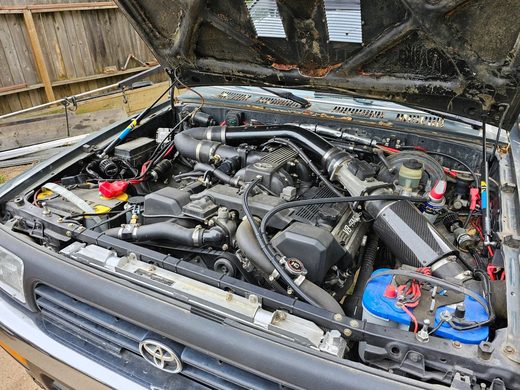
3VZE Running Hot? The Overheating Diagnosis Chain
Don't skip to the scary answer
Every 3VZE owner who watches the temp needle climb thinks the same two words. Sometimes it is the head gasket — but a lot of "failing gaskets" turn out to be a forty-dollar cooling part. Work the chain in order and let the evidence decide.
Step one is embarrassing but essential: is the coolant actually full, at the radiator, checked cold? The overflow tank can read fine while the radiator itself is low. If you're losing coolant with no external leak, that does point toward the gasket conversation — read our head gasket symptoms guide alongside this one.
The chain, in order
The fan clutch. With the engine off and cool, spin the fan by hand — it should resist and stop within about a turn. A fan that free-spins like a toy is done, and a dead fan clutch is one of the most common 3VZE overheat causes, showing up worst at idle and low speed with temps recovering on the highway.
The thermostat. Cheap, buried, and famous for sticking. Overheats that come on fast from cold, or wild temperature swings, smell like a thermostat. Replace with an OEM-style unit — this is not the part to save four dollars on.
The radiator. Three decades of scale narrows those cores. If the tanks show crust, the fins crumble, or the truck only overheats towing or climbing, airflow and capacity are your issue. While you're there, confirm the radiator cap holds pressure — a weak cap lowers the boiling point of the whole system and mimics bigger problems.
The timing. An engine running retarded timing runs hot. If the truck has been fiddled with, verify base timing is set to spec before condemning hard parts.
Reading the verdict
If every link in the chain checks out and the truck still loses coolant or overheats, then you've earned the gasket conversation honestly — no guessing, no parts cannon. And if a fan clutch or thermostat fixes it? You just saved four figures with an afternoon of methodical work. That's the whole 2nd gen ownership experience in one story.