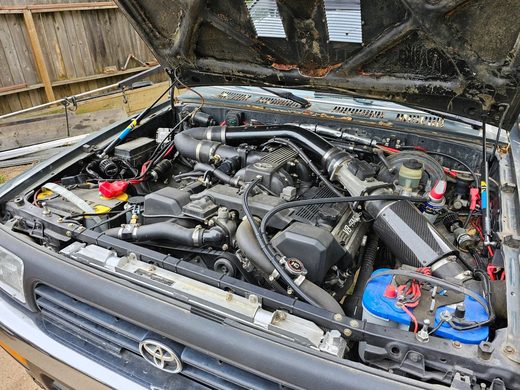
22RE Valve Adjustment: The Tappet Tick and the Feeler-Gauge Cure
The 22RE is old-school in the best and most demanding way: solid lifters. No hydraulic self-adjustment — the valve clearances are set mechanically, they drift with wear, and the engine tells you when they're off with the famous tappet tick: a rhythmic sewing-machine clatter from the valve cover that speeds up with RPM.
What the tick actually means
Loose clearance ticks — annoying but merciful, because you can hear it. The quiet danger runs the other way: clearances that go tight make no noise while holding valves slightly open, burning them over time. Which is why "it's not ticking" isn't the same as "it's adjusted," and why this job lives on a schedule, not a symptom, on every solid-lifter Toyota.
The job, honestly framed
This is patience work, not skill work: valve cover off, engine rotated to put each cylinder at its checking position, and every clearance measured with feeler gauges against spec — intake and exhaust carry different numbers, and the factory manual's figures are the law here. Out-of-spec valves on the 22RE are corrected the old way, and the discipline is measuring everything, recording everything, and never guessing. An afternoon with a notebook, done right, buys years of correct.
While the cover is off
Read the top end: even, oil-wet cam lobes and clean galleys are the healthy signature; scored lobes or sludge are messages. Replace the valve cover gasket on reassembly as a rule — a baked gasket re-used is next month's oil weep (the "gasket weeping" search is its own 5,000-a-month club). And torque the cover gently; crushed gaskets leak on day one.
The tick that isn't valves
Two impostors: an exhaust manifold leak — the 22RE's famously crack-prone manifold ticks loudest when cold and fades warm as the metal expands shut — and the timing chain rattle from the front of the engine. Location and behavior separate them: valve tick is top-of-engine and constant once warm; manifold tick fades with heat; chain rattle lives at the front and hates cold starts. Diagnose by ear before diagnosing by wallet, the same philosophy as the 300k playbook.
Frequently asked questions
Is the 22RE tick harmful?
A light tick from slightly loose valves is mostly annoying — but it means the schedule slipped, and its silent sibling (tight valves) burns valves. Adjustment time either way.
How often should 22RE valves be adjusted?
On the factory schedule — and any time the top end is apart, and whenever the tick appears. On a truck with unknown history, assume it's never been done.
Can tight valves really damage the engine silently?
Yes — a valve held fractionally open leaks combustion past its seat and slowly burns. Tight is worse than loose, and tight is silent.
My tick fades as the engine warms — is that valves?
Probably not. A tick that fades with heat is the classic cracked exhaust manifold signature; valve tick stays once the engine is warm.