2nd Gen 4Runner Power Steering Leaks & the Drag Link Campaign
The usual suspects
Power steering complaints on 30-year-old 4Runners come down to a short list: the pump itself (whining, especially at full lock, and seepage around the pulley shaft), the high-pressure hose (wet line, drips after parking), and the steering gearbox seals (fluid tracking down the pitman shaft).
A quick health check costs nothing: open the reservoir cap and smell the fluid. Burnt-smelling, dark fluid means the system has been running hot and low for a while. A fluid drain-and-refill on a tired but not-yet-leaking system quiets the pump and buys real time — owners running 250k on original pumps swear by it.
If you're topping off more than a couple times a season, stop guessing and trace it: clean everything with degreaser, drive a week, and the fresh wet trail points at the source.
The drag link campaign — check your VIN
Separate from leaks but living in the same system: Toyota ran a service campaign on the steering drag link (relay rod) for these trucks — the part connecting the steering box to the tie rod ends. Community knowledge usually cites it as campaign #50N. A worn or affected relay rod is not a maintenance item to gamble on; it's the link between your steering wheel and the front wheels.
The move: call any Toyota dealer with your VIN and ask whether the steering campaign work was completed on your truck. Like the head gasket program, it's in their records. If it was never done, ask what they'll honor — and either way, have the drag link ends inspected at your next alignment. Play in the steering that an alignment can't cure often lives here.
While you're under there
Any time the front end is on stands for steering work, put hands on the panhard-to-axle relationship too, especially on lifted trucks — a lift changes the geometry, and an adjustable panhard bar is how you re-center the axle properly instead of living with a truck that dog-tracks.
Find where it's actually coming from
Power steering fluid travels. By the time you see a drip on the driveway, it may have run a long way from the source, so trace it upward rather than guessing at the nearest component.
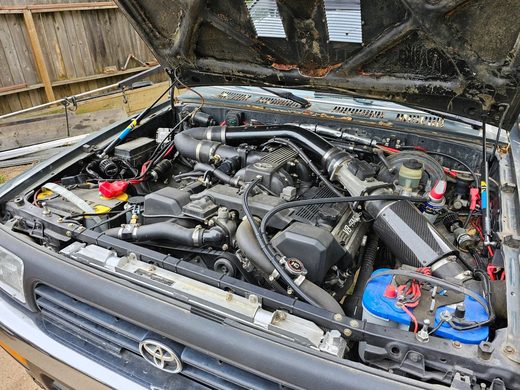
Clean everything in the area first — degreaser, then dry it — and drive it. A clean engine bay makes the source obvious in a day. Trying to find a leak in thirty years of accumulated grime is how people replace the wrong part.
Common sources, roughly in order: the pump's shaft seal, the high-pressure hose and its crimped ends, the return line where it's softened with age, the gearbox input shaft seal, and the sector shaft seal at the bottom.
Symptoms that come with it
Whining that rises with steering effort — usually low fluid, and low fluid usually means a leak you haven't found.
Groaning at full lock — normal in small doses on these trucks, a warning sign if it's new.
Foam in the reservoir — air is getting in, which points at a suction-side leak rather than a pressure-side one.
Heavy steering that comes and goes — check level and belt tension before assuming the pump is dying.
Don't ignore the level while you decide
Running a power steering pump low is how a leak becomes a pump replacement. Whatever your plan is for the actual repair, keep it topped up in the meantime — that's the cheap insurance that keeps this a small job.
Steering slop is a separate conversation
Worth separating clearly, because these get conflated: a leak is a fluid problem, and vague, wandering steering is a wear problem. Ball joints, tie rod ends, the idler arm, the pitman arm, and worn steering rack bushings all produce vagueness, and none of them leak.
If your truck both leaks and wanders, you have two jobs, not one. Fixing the leak won't tighten the steering, and people are frequently disappointed by that.
Frequently asked questions
Will a stop-leak additive work?
It can slow a seep temporarily. It doesn't repair anything, and some formulations swell seals in ways that complicate the real repair later. Use it as a stopgap, not a solution.
How do I know if the pump itself is bad?
Noise that persists after the level is correct and the belt is tight, plus poor assist, points at the pump. But confirm the fluid and belt first — they're free to check.
Can I keep driving with a slow leak?
If you monitor the level religiously, yes. The failure mode that hurts is running it dry, not the leak itself.
New guides, first look at new parts
We publish a guide most weeks and build parts for one truck. If you own a 2nd gen, put your email in and you’ll get both. No filler.
One email at a time, unsubscribe in a click.