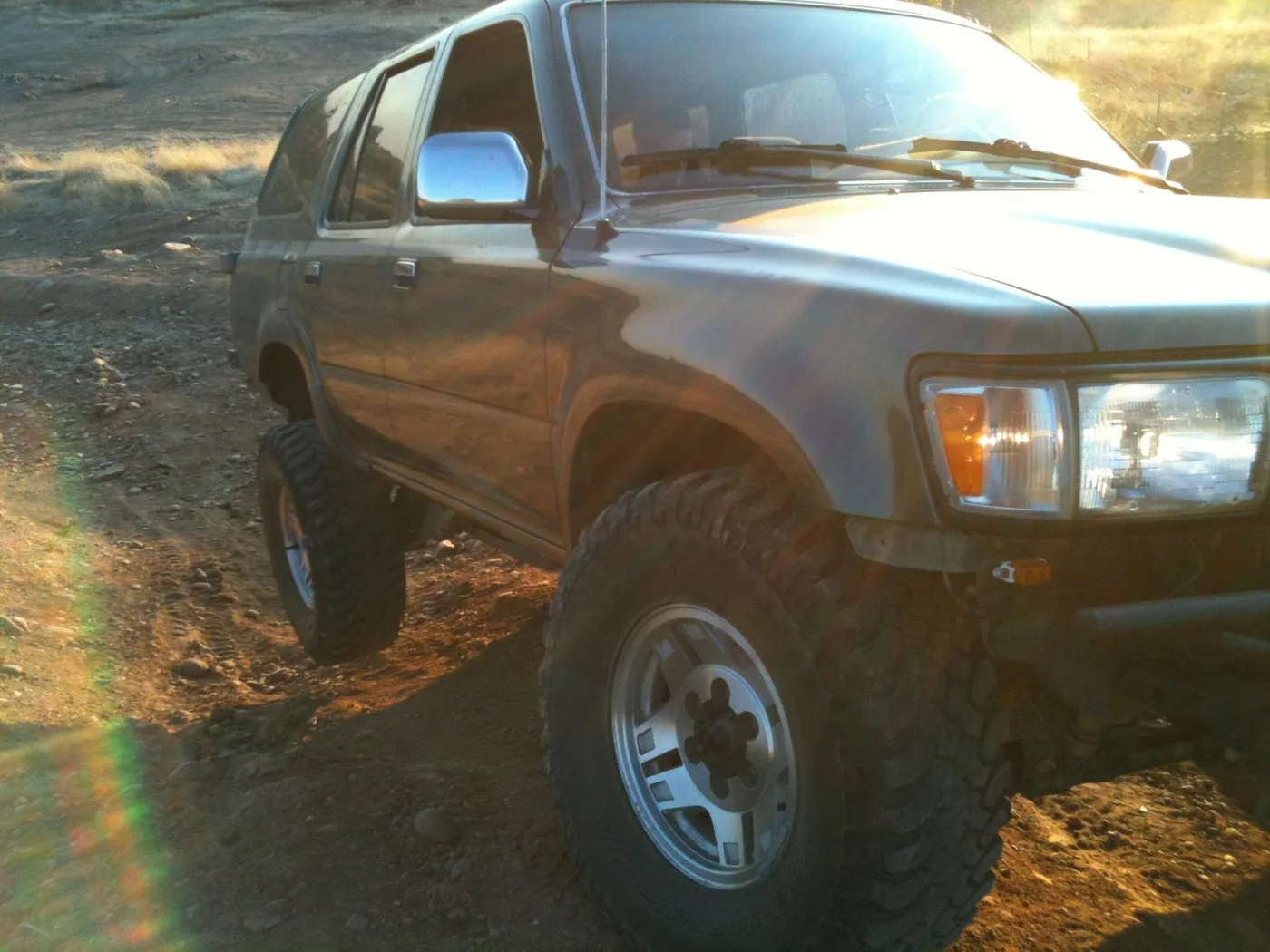
2nd Gen 4Runner CV Axles After a Lift: What Actually Changes
By Jay — 2nd gen 4Runner owner & builder, Standard American Outdoors
Lift a 4WD 2nd gen 4Runner and the front CV axles start working harder than they did stock. Not because the parts got weaker — because the geometry changed underneath them.
This is one of the most common questions we get from guys installing a 3-inch lift kit for the first time: are my CV axles going to hold up? Here's the actual mechanics of what's going on, so you can tell the difference between normal wear and a real problem.
Why lifting increases CV joint wear
The front CV axles on a 2nd gen 4Runner run from the front differential out to each front hub. Each axle has two constant-velocity joints — an inner joint that lets the axle plunge in and out as the suspension moves, and an outer joint that lets the wheel steer and articulate while still delivering power smoothly.
Every CV joint is designed around a range of operating angles. Toyota engineered that range around stock ride height and stock suspension travel. Lift the truck and you change the relationship between the differential, the control arms, and the hub — which means the axle now sits at a steeper angle at rest than it did from the factory, before the suspension even moves.
A steeper resting angle means the joint works closer to its limit through more of its travel. That shows up as more friction and heat inside the joint, a harder fold at the boot on every rotation, and boots that wear and split sooner than stock. More lift generally means more angle, and more angle means faster wear — that's true whether the lift came from our kit or anyone else's.
Symptoms of a failing CV joint or axle
Know these and you'll catch a problem long before it strands you:
- Clicking or popping on turns — the classic outer CV joint symptom. Worse at full steering lock, so it's most noticeable in parking lots and tight U-turns.
- Grease slung on the inside of the wheel or lower fender — a sign the boot has torn and is flinging grease out, and letting dirt and water in.
- A vibration that changes with speed or load — it can be the axle, but check motor mounts and other driveline components before assuming it's the CV joint.
- A visibly torn, cracked, or missing boot — inspect this directly. If you can see the joint or its grease from outside, it's already contaminated.
The boot is the real point of failure. Once it splits, grease escapes, dirt and water get in, and the joint itself is usually not far behind. Catching a torn boot early is the difference between a cheap fix and a full axle replacement.
Are stock CV axles OK after a 3-inch lift?
Straight answer: generally, yes. Three inches is a lift height most 2nd gen platforms tolerate reasonably well with the stock axles still in place. It's a big enough geometry change that you'll see faster wear than a stock-height truck, but it's not enough to push most trucks into the kind of extreme angles that cause outright binding or short-term failure.
That said, "tolerate" isn't the same as "ignore." At 3 inches, inspect your CV boots more often than you would on a stock-height truck — every oil change is a reasonable habit, and definitely before and after any long trip or trail run. Look for cracking at the folds, not just obvious tears. A boot that's dry, glazed, or starting to crack at the pleats is close to failing even if it hasn't split yet.
When to consider aftermarket or HD axles
Stock replacement axles are the right call for most 3-inch-lifted trucks — same geometry tolerance, lower cost, easy to source. But there are situations where it's worth stepping up:
- You're running more than 3 inches of lift, especially combined with larger tires and more sidewall flex.
- You're wheeling hard — real articulation, not just fire roads — where the suspension sees full droop regularly.
- You're already on your second or third torn boot on the same axle in a short window, which usually means the joint itself is worn out, not just unlucky.
- Your current axles are high-mileage and due for replacement anyway — if you're already doing the job, upgrading costs little extra in labor.
If none of that describes your truck, don't overspend. A well-maintained stock axle on a 3-inch lift will outlast most owners' patience for keeping the truck stock in the first place.
One more thing before you lift
If you're planning a lift and want to go in with your eyes open, this is exactly the kind of thing to know before you install SAO's 3-inch lift kit — not because the axles are a weak point, but because the inspection interval on your CV boots is about to get shorter, and it's a lot cheaper to catch a torn boot than to replace a seized joint.
Frequently asked questions
Does a 3-inch lift automatically require longer CV axles?
No. At 3 inches, most 2nd gen 4Runners keep working fine with stock-length axles. Longer or extended axles generally become a conversation at bigger lift heights, not at 3 inches.
How often should I check my CV boots after lifting?
Every oil change is a reasonable baseline, plus a quick visual check before and after any trail run or long highway trip. It takes two minutes with the wheel off or a flashlight and a mirror.
Can I just re-tape or re-clamp a torn CV boot instead of replacing it?
Not once it's actually torn. By the time you can see a tear, grease has likely already escaped and dirt has gotten in. A new boot on a contaminated joint just delays the real repair — the joint needs to be cleaned, repacked, and resealed at minimum.
Is clicking on turns always the CV joint?
It's the most common cause, especially if it's worse at full steering lock. But worn wheel bearings and loose suspension components can produce similar noises, so don't assume without a look underneath.
Does the rear axle wear faster after a lift too?
The rear axle on a 2nd gen 4Runner isn't a CV-jointed axle — it's a solid rear axle, so the CV wear conversation is specifically a front-axle, 4WD issue.
New guides, first look at new parts
We publish a guide most weeks and build parts for one truck. If you own a 2nd gen, put your email in and you’ll get both. No filler.
One email at a time, unsubscribe in a click.